Created to Create, Part 1: Image Bearers

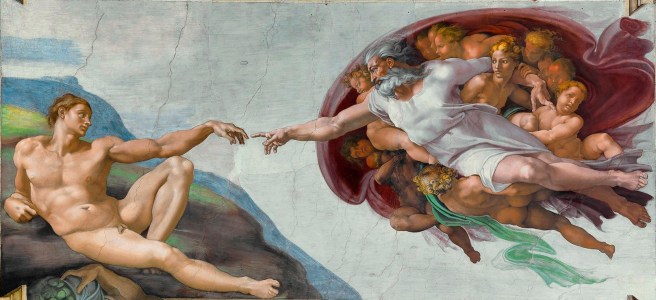
Header image credit: me // Featured image credit: Michelangelo (public domain, via Wikimedia Commons)

What makes humans special?

Humans have probably been asking that question for probably as long as we’ve existed. For much of that time, I imagine that question focused on a particular variation: what separates us from the animals? Language, consciousness, problem-solving, and tool use are some of the more convincing answers, but not convincing enough. We needn’t look far into the animal kingdom to find sophisticated communication, self-awareness, clever solutions to problems, and the shaping and use of tools.

In recent decades, the arguably more pressing variation of the question is a technology-focused one: what separates us from the machines? Or, phrased differently, what makes human intelligence different from artificial intelligence? I’ll address the first question in this post, but you’ll have to wait for part two to hear my rant about—I mean my answer to the second.

Continue reading

Easy Come, Easy Go: The Surprising Paradox of Task-Switching

Header image credit: me // Featured image credit: Jonathan Farber (freely available via Unsplash)

What do pit orchestra and my dissertation have in common? Well, aside from the fact that I maybe read some relevant articles during the occasional rehearsal and/or show (or, more often the case, discovered that articles weren’t as relevant as I thought they might be), almost nothing…aside from one thing: task-switching. As a reed player, I have doubled for most of the shows I’ve done, meaning I play multiple instruments, usually in the clarinet and/or saxophone families, though I have done some flute (not my forte—but not my piano either). Though still playing music, when switching between instruments, I’m essentially switching between tasks (at least as psychologists would define task-switching), because I’m alternatingly applying different sets of rules (i.e., fingerings). When doing this, rules will inevitably be misapplied (i.e., I play the wrong note).

Continue reading

Music Is the Food of the Brain. Play On.

Header image credit: me // Featured image credit: me

“Music […] gives soul to the universe, wings to the mind, flight to the imagination, and charm and gaiety to life and to everything.”
Plato

I love music. I love listening to it. I love playing it. I love talking about it. I can be a bit snobbish about my preferences for it (but I’m working on that). But, really, music is music, and that makes it great. It can be enjoyed by people of all nations, for there is no language barrier in music. (Case in point: when I was in Berlin several years ago, I went to see Carmen. If you’re not familiar with that opera, it’s sung in French…which I don’t speak. Being in Berlin, the surtitles were in German…which I can’t read. Needless to say, I was clueless about the plot. But, I was still able to enjoy the music and the performance, both of which were stunning.) It brings people together for a common purpose of making or listening to something beautiful, and there is something so uniquely special in an ensemble of individuals playing together as one. Music speaks to our emotions and helps us express them in ways that our words can’t. It’s food for the soul.

It’s also food for the brain.

Continue reading