Created to Create, Part 1: Image Bearers

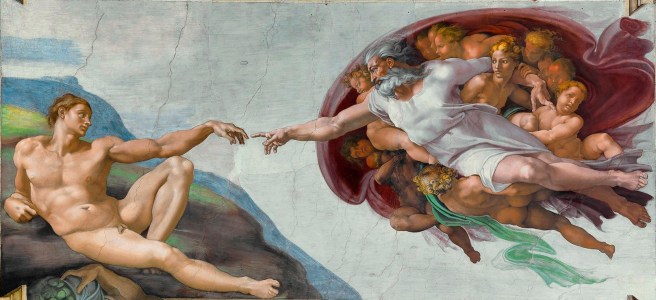
Header image credit: me // Featured image credit: Michelangelo (public domain, via Wikimedia Commons)

What makes humans special?

Humans have probably been asking that question for probably as long as we’ve existed. For much of that time, I imagine that question focused on a particular variation: what separates us from the animals? Language, consciousness, problem-solving, and tool use are some of the more convincing answers, but not convincing enough. We needn’t look far into the animal kingdom to find sophisticated communication, self-awareness, clever solutions to problems, and the shaping and use of tools.

In recent decades, the arguably more pressing variation of the question is a technology-focused one: what separates us from the machines? Or, phrased differently, what makes human intelligence different from artificial intelligence? I’ll address the first question in this post, but you’ll have to wait for part two to hear my rant about—I mean my answer to the second.

Continue reading

The Happiness—and Holiness—of a Life Lived Joyfully

Header image credit: me // Featured image credit: cmophoto.net (freely available via Unsplash)

“Don’t try to add more years to your life. Better add more life to your years.”
Blaise Pascal

With no disrespect to Pascal and his genius, while I agree with the latter part of his above assertion, I don’t agree with the first part. Yes, it is far more important to fill our years with life than it is to fill our life with years, but that doesn’t mean that we shouldn’t try to add years. There are lots of things we can do to promote longevity, and, by all means, let’s do those things; let’s do what we can to live longer. But we must beware of confusing quantity with quality. We mustn’t focus so much on lengthening life that we forget to enjoy life for however long we have it.

After all, joylessness might just be the most innocuously damaging sin we didn’t know we were committing.

Continue reading

From the Heart No. 1: On Goals (Or, Great Expectations II: The Problems and the Pitfalls)

Header image credit: me // Featured image credit: me

I’m going to do something a little different in this post, what I intend to be the first of many such occasional posts: rather than talk about science and connect lots of interesting facts and findings together, I’m going to speak from the heart and use anecdotal experience rather than empirical evidence to make my points. (Wow, and even in that disclaimer, I still sound like scientific fact man. So on with it already!)

Continue reading

Great Expectations: The Fact and the Fiction (But Not the Fictional Novel, Sorry)

Header image credit: me // Featured image credit: me

Thomas Edison. One of the world’s most recognized and renowned inventors. Also, supposedly, addled as a child. While tales of the incident have been exaggerated, as Snopes reports, as a boy, Edison had overheard a teacher describe him as addled and not worth keeping in school. Upon hearing of the incident, his mother (and apparently his greatest champion) angrily told off the teacher, telling him that her son had more brains than he did. Young Edison’s response was a resolved determination to “be worthy of her and show her that her confidence was not misplaced.”

That’s the power of positive expectations.

Continue reading

What Is a Renaissance Man?

Header image credit: me // Featured image credit: me

Da Vinci. Pascal. Descartes. Newton. Einstein. They broke molds. They pushed boundaries—not just the boundaries of their disciplines, but of themselves, of who they were. Discontented with the gap between what was and the what could be, they pressed on; they persevered; they made progress; they advanced. And as they did, they brought with them their disciplines, their peers, and their societies; their advances advanced humanity. We owe them a great debt, these renaissance men.

Continue reading